Loading…
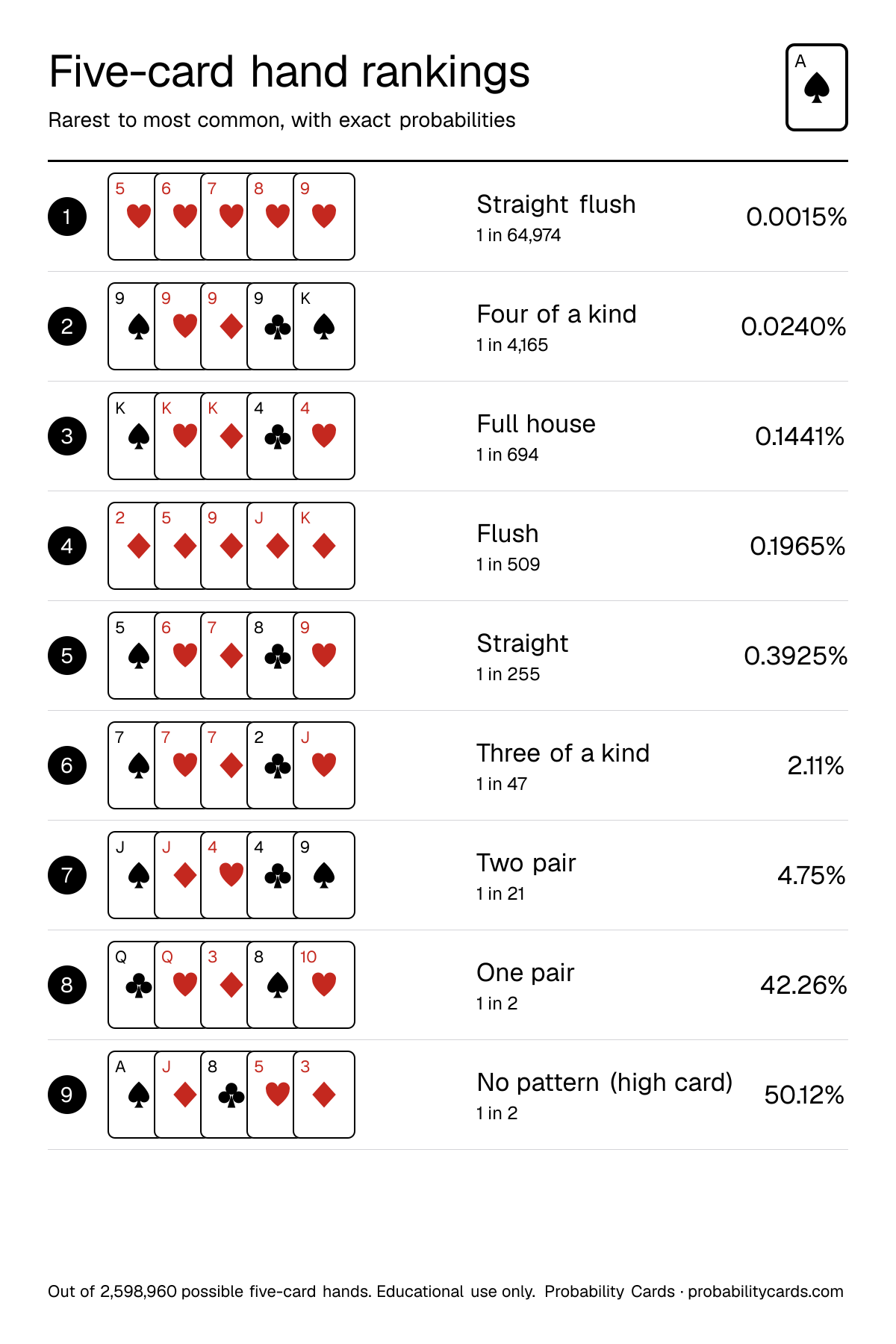
Straight flush
Five consecutive ranks, all of one suit (the ace may count high or low).
0.0015%
1 in 64,974
40 hands
Four of a kind
Four cards of one rank plus one other card.
0.0240%
1 in 4,165
624 hands
Full house
Three cards of one rank and two of another.
0.1441%
1 in 694
3,744 hands
Flush
Five cards of one suit that are not consecutive.
0.1965%
1 in 509
5,108 hands
Straight
Five consecutive ranks that are not all of one suit.
0.3925%
1 in 255
10,200 hands
Three of a kind
Three cards of one rank and two unmatched cards.
2.11%
1 in 47
54,912 hands
Two pair
Two different pairs plus one unmatched card.
4.75%
1 in 21
123,552 hands
One pair
Exactly two cards of one rank and three unmatched cards.
42.26%
1 in 2
1,098,240 hands
No pattern (high card)
None of the above: all ranks differ, not consecutive, not all one suit.
50.12%
1 in 2
1,302,540 hands
The ranking is simply an ordering by how many of the 2,598,960 possible five-card hands belong to each type: fewer hands means a higher rank. The ace may count high or low in a straight (A-2-3-4-5 and 10-J-Q-K-A), and a royal flush is the highest straight flush.
The numbers are exact: each count comes from a counting argument you can reproduce with combinations. See how every count is derived, or run the simulator to watch experiments approach these values. Teachers can also use the free printable worksheets.